🚨Chapter 11 – The Happiness the Night Sky Gives Us| Stars..
🚨The Happiness the Night Sky Gives Us | Stars, Constellations, the Moon & the Aurora as Comfort
Introduction — A Story That Begins the Moment We Look Up
When the noise of the day fades and the window turns dark, we instinctively tilt our heads back. What greets us in that instant is a landscape humanity has never fully possessed, even after thousands of years: the night sky. Between city lights or above a pitch-black countryside field, the night sky has always been there. And strangely, simply looking up at it lets something in us quietly settle.
In this chapter, we walk through the elements that make up the night sky — stars, constellations, the moon, and the aurora — and explore how each season colors our feelings toward it differently, along with the myths, poems, and songs woven into it, and the dreams humanity has carried while gazing upward.
1. Stars — Living Comfort from Dead Light
The first thing our eyes find in the night sky is the stars. Most starlight we see left its source years, centuries, even tens of thousands of years ago. Some of the stars we’re looking at right now may already be gone. And yet their light still reaches us, still fills the sky.
Strangely, this fact becomes a comfort. Even after time passes, even after something ceases to exist, whatever once shone leaves a trace behind. It makes us wonder whether a single word we once spoke, or a small piece of our heart we once gave away, might reach someone else later — like starlight — and become a comfort of its own.
Counting stars is itself an ancient human habit. Almost everyone has, on some sleepless night, counted the stars outside their window. Counting stars solves nothing, really — but the simple act has a way of settling the mind and putting scattered thoughts back in order.
2. Constellations — Stories Humans Drew Across the Sky
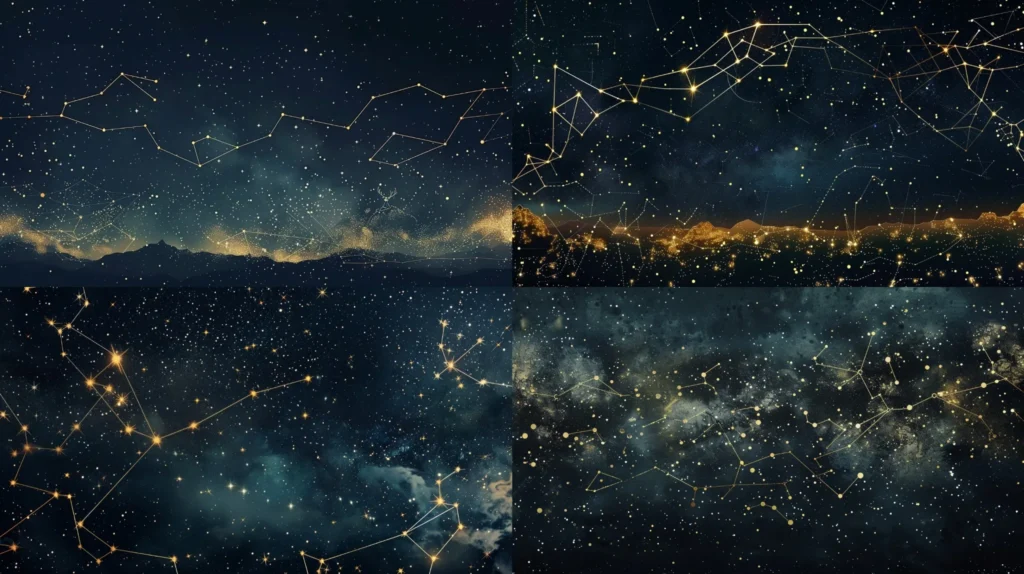
Constellations don’t actually exist in the sky; they are stories humans created by drawing lines between stars. Orion, Cassiopeia, Ursa Major — these names all come from myth and legend. Etching the shape of a hunter, a queen, or a bear onto the heavens is, in the end, proof that humans have always wanted to find meaning among what looks like meaningless scattered points.
For navigators, constellations were a compass pointing the way. For farmers, they were a calendar marking the seasons. For lovers, they were the backdrop for vows of love. The fact that entirely different stories were drawn from the very same stars, depending on era and culture, shows just how freely humanity has imagined in the presence of the sky.
Even now, searching for Cygnus crossing the summer Milky Way, or Orion blazing in the winter sky, is the same act our ancestors performed thousands of years ago. Within that continuity, we find a quiet sense that we are not alone.
2-1. The Constellations That Guard the Sky All Year — Circumpolar Stars
Most constellations rise and set with the seasons, but a handful circle the North Star so closely that they never dip below the horizon at all. These are called circumpolar constellations. At mid-northern latitudes (around 37°N, where Korea sits), five circumpolar constellations remain visible year-round:
- Ursa Minor — home to Polaris, the North Star, which has served as the sky’s compass point since ancient times.
- Ursa Major — better known by its “Big Dipper” asterism, and the classic reference point for locating Polaris.
- Cassiopeia — instantly recognizable by its “W” shape, sitting directly opposite Ursa Major across the North Star.
- Draco — a long, winding constellation that curls between Ursa Major and Ursa Minor like a serpent.
- Cepheus — a modest, house-shaped constellation that stands beside Cassiopeia, keeping watch over the pole alongside it.
Because these five constellations hold their place through every season, they make excellent landmarks for anyone just starting to read the night sky. Alongside them, other constellations rise and set with the calendar: Leo takes the stage in spring, the “Summer Triangle” of Cygnus, Lyra, and Aquila dominates summer nights, Pegasus rises in autumn, and Orion commands the winter sky. Together, the ever-present circumpolar stars and the seasonal visitors complete the night sky’s yearly cycle.
2-2. Myths and Stories Woven Into the Constellations
Nearly every constellation carries a story hidden within it — of love and jealousy, punishment and longing.
Orion and Scorpius — In Greek myth, the hunter Orion grew overconfident in his own strength and was killed by a scorpion’s sting. To this day, Orion and Scorpius never share the sky: when Scorpius rises, Orion sets, and when Orion rises, Scorpius has already vanished — as if two old enemies are destined never to meet again.
Cassiopeia’s Vanity — Queen Cassiopeia once boasted that her beauty surpassed that of the sea nymphs, and for her arrogance, she was bound to a chair and sentenced to circle the heavens forever. The way Cassiopeia’s constellation appears to hang upside-down at certain times of year traces directly back to this myth.
Ursa Major and Ursa Minor — The nymph Callisto and her son Arcas were transformed into a great bear and a small bear out of the goddess Hera’s jealousy. Just as the son, not recognizing his mother, was about to draw his bow against her, Zeus lifted them both into the sky, binding them together forever. A moment that nearly ended in tragedy became, in the night sky, an eternal companionship.
Cygnus — This constellation traces back to the myth of Zeus transforming into a swan to approach the beautiful Leda. On summer nights, it spreads its wings wide, gliding directly through the heart of the Milky Way.
Korea’s Big Dipper Folktale — The Big Dipper carries its own special meaning in Korean folklore. According to one old tale, seven poor brothers drew water for their sick mother night after night, and the heavens, moved by their devotion, transformed the brothers into stars. For this reason, generations of Koreans have set out a bowl of clear water beneath the Big Dipper and prayed toward it for their wishes. That East and West etched entirely different stories onto the very same seven stars shows just how boundless human imagination becomes in the face of the night sky.
3. The Moon — The Closest Companion of the Night
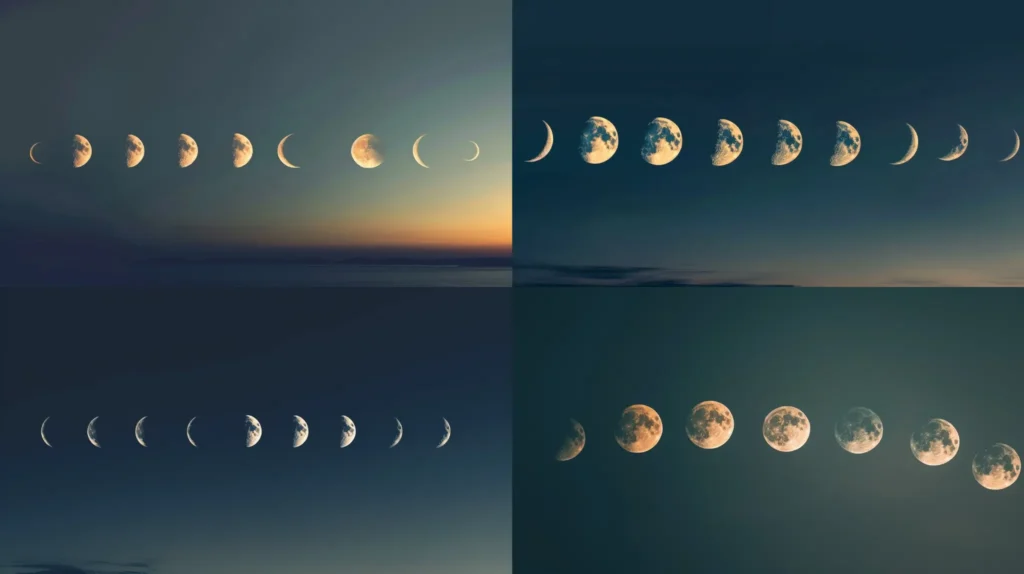
The moon is the most familiar presence in the night sky. Watching it shift shape night by night, humans learned to measure the passage of time. The anticipation of a crescent moon, the fullness of a full moon, the quiet melancholy of a waning moon — the moon’s phases have become a language of emotion all their own.
Across nearly every culture in the world, the moon appears as a symbol of longing and reunion. The thought that someone far away might be looking at the very same moon offers a comfort that crosses physical distance. Simply imagining that someone you love, somewhere out there, might be looking up at tonight’s moon right along with you is enough to warm the heart.
4. The Aurora — A Miracle Painted by the Sky
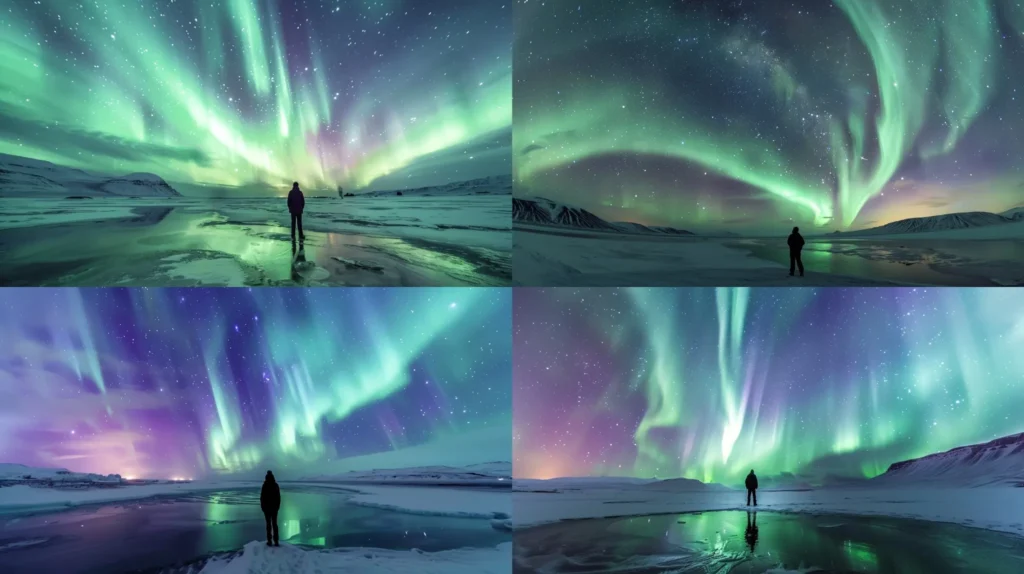
The aurora is the night sky at its most dramatic. Curtains of green and violet, sometimes streaked with red, dancing across the heavens — scientifically explained as the interaction between solar wind and Earth’s magnetic field, yet to anyone seeing it for the first time, it always feels like a miracle.
In many legends of the Nordic and Arctic regions, the aurora was described as the souls of the dead, or as a festival held by the gods. It’s fascinating that even in the face of a phenomenon science can fully explain, humans still reach for mystery. People who have witnessed the aurora almost universally describe falling silent, sometimes even weeping — likely because in that moment, they feel, all at once, how small and yet how singular they are.
5. How the Night Sky’s Mood Shifts With the Seasons
The same sky wears an entirely different face depending on the season.
- Spring nights carry a certain softness, even through lingering chill. Just as a heart that curled inward through winter slowly begins to unfurl, spring starlight feels tentative and full of quiet anticipation.
- Summer nights are the most alive. This is the season the Milky Way is at its clearest, and even through the heat of a tropical night, looking up at the sky becomes the one true rest from the day’s warmth.
- Autumn nights are contemplative. As the air clears, the stars grow especially sharp, and gazing at the sky in that crisp, faintly desolate breeze naturally turns the mind toward reflection on time already passed.
- Winter nights are the coldest, yet the most vivid. This is the season Orion shines most distinctly, and starlight glittering through frozen air offers, paradoxically, the deepest comfort of all.
Following how the night sky’s expression changes with each season, we come to realize just how closely nature’s rhythm mirrors the rhythm of our own hearts.
6. Stories, Poems, and Songs Woven Into the Stars
Humanity has never simply looked at the night sky — it has continually translated it into stories, into writing, into song. The Greek myth of Orpheus searching for his beloved Eurydice, and the East Asian legend of the Weaver Girl and the Cowherd crossing the Milky Way once a year to reunite — both are narratives of love and longing set against the backdrop of the night sky.
Poets, too, have searched for language in front of the night sky. In “Counting Stars at Night,” the Korean poet Yun Dong-ju gave each star the name of a memory, a love, a longing. What he was counting was never merely celestial bodies — it was the fragments that made up his own life.
John Keats: Bright Star, Would I Were Steadfast as Thou Art
Yun Dong-ju: Counting Stars at Night
Songs carry the same thread. Countless pieces of popular music and ballads have used the stars and the moon as metaphors for love, separation, and longing. The moment the night sky becomes the backdrop, a song seems to gain a deeper resonance — likely because the night sky is one of the most honest canvases on which human emotion can be painted.
Travel Sketch – The Stars Are Setting
Coldplay – A Sky Full of Stars
BTS -Mikrocosmos
A Dream That Fades Like Starlight
7. What Humanity Has Dreamed While Looking Up
Ancient peoples looked to the night sky hoping to read the will of the gods. Navigators used it as a guidepost and sailed into unknown seas. Scientists have searched within starlight for the origins of the universe, and poets have searched within it for the meaning of life.
And what about the rest of us, in our ordinary lives? On a hard day, when we open a window at night and look up, we’re not really hoping for some grand answer. We simply wish that, within this vast universe, our worries might feel a little smaller — and, because of that, a little lighter to carry.
Looking up at the night sky, in the end, comes from a desire to connect with something larger than ourselves, and within that connection, to reconfirm our own place in it.
8. The Comfort of the Night Sky — What We Ultimately Receive
The night sky demands nothing. It doesn’t judge, and it doesn’t rush. It simply shines quietly where it is, giving whoever looks up the time to respond at their own pace.
And so, standing beneath the night sky, people find themselves gradually setting down whatever weight they carry. We wish on stars, think of someone we miss when we see the moon, and grow humble before the vastness of the world when we glimpse the Milky Way. All of these small moments, gathered together, form what we so often call “the happiness the night sky gives us.”
Closing
The night sky is a lighthouse as old as human history itself. When we lose our direction, when our hearts feel heavy, we still tilt our heads back and search for its light. Stars and constellations, the moon and the aurora — across every era, they all carry the same message to us: “You are not alone.”
Tonight, consider pausing for a moment and looking up. Within the thousands of years of stories held there, a small comfort you need right now may be waiting for you as well.

You May Also Like

🚨Chapter 3: The Metric of Enough

🚨Chapter 10. A Small Lighthouse in the Heart — How Classical Music Gently Holds Us