🏛️Chapter 22: The Mirage of the Golden Ticket
🏛️Why, exactly, have we allowed college admissions to hold our very souls hostage?
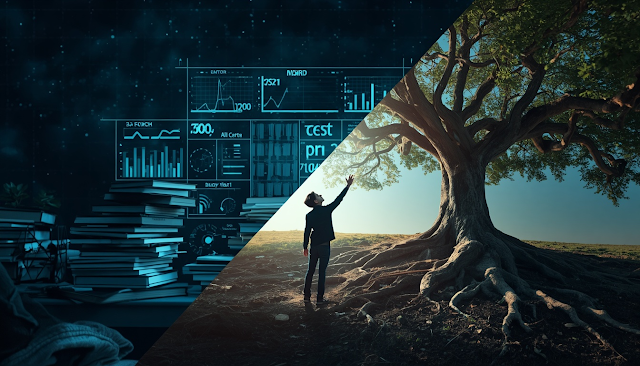
(A brutal sprint toward a foggy future ruled by AI, holding an obsolete golden ticket.)
![[The Present, Map of Self, Modern Deficit] Chapter 22-1](https://ourtimelessnotes.com/wp-content/uploads/2026/07/The-Present-Map-of-Self-Modern-Deficit-Chapter-22-1.png "🏛️Chapter 22: The Mirage of the Golden Ticket 2")
[Introduction]
Whether in America or Korea, in any nation that sanctifies education, the wall of ‘college entrance exams’ is the most massive and brutal gateway that an entire family must cross together. Having personally passed through that fierce tunnel as a parent, I know its weight better than anyone. Within this colossal race, not only the child but also the parents become fellow examinees. The child’s report card becomes the parents’ report card, and a bizarre psychological synchronization occurs where the child’s acceptance or rejection defines the success or failure of the entire family. Why have we mortgaged our entire souls to college entrance exams like this?
![[The Present, Map of Self, Modern Deficit] Chapter 22-2](https://ourtimelessnotes.com/wp-content/uploads/2026/07/The-Present-Map-of-Self-Modern-Deficit-Chapter-22-5.png "🏛️Chapter 22: The Mirage of the Golden Ticket 3")
[The Divergent Dreams of Parent and Child: The Trap Named Success]
What sustains this cruel race is a single, towering belief: the myth that ‘one must go to a prestigious university and an elite major—not just any college or any department—to finally live a stable and successful life.’
The parent’s gaze is desperate. It projects a devotion to ensuring their child does not inherit the limitations and failures they once faced, or the unique anxiety of immigrant and Korean societies to ensure their children live proudly and on equal footing with mainstream society.
Conversely, the child’s gaze is lonely. Without time to explore what they love or what kind of human being they are, they must run forward like a racehorse. Even if they cross that wall through blood, sweat, and tears, what awaits them is not a guaranteed future, but merely the start of another competition. In this process, the emotional isolation and deficit of identity among youth remain the most painful facets of modern society.
![[The Present, Map of Self, Modern Deficit] Chapter 22-3](https://ourtimelessnotes.com/wp-content/uploads/2026/07/The-Present-Map-of-Self-Modern-Deficit-Chapter22-2.png "🏛️Chapter 22: The Mirage of the Golden Ticket 4")
[The Upheaval of the Era: AI and Robots Invading Human Domains]
Yet, the greatest tragedy lies in the fact that the map we are trying to hand our children has already become obsolete. Today, the pace of development in digital technology, AI, and robotics is steeper than humanity ever imagined. A significant portion of the specialized and glamorous professions once guaranteed by graduating from a ‘good university and a good major’ has now become the easiest target for AI replacement.
While we are cramming volumes of knowledge into our children to make them fight against human competitors, a new rival has emerged from behind—a powerful AI that learns tens of thousands of times faster than humans. At this juncture, where the paradigm of professions is completely shifting, the infinite competition of college entrance exams chasing past rote-knowledge and prestige is, perhaps, a desperate sprint toward a massive mirage.
[Conclusion: Parents as Secure Bases Rather Than Navigators, and the Path for Students]
Then, how should our examinees and parents navigating this foggy era break through this wall?
First, the role of the parent must change. Parents must give up trying to be the ‘navigators’ who predetermine and direct their child’s life path. Instead, they must become a solid ‘secure base’ where the child can always return to rest, no matter what path they choose in a rapidly changing world, and even if they lose their way and fail. When parents provide the trust that says, “Even if you do not go to a prestigious university, you are valuable simply for who you are,” children finally gain the courage to challenge the future.
Students, too, must break away from the mechanical competition of memorizing volumes of knowledge. The coming era will belong not to those who excel at matching pre-existing answers, but to those who ask ‘uniquely human questions’ that machines cannot formulate, and those who empathize and unite with others. University is not the final destination of life, but merely one of many stations. When children cultivate their own ‘inherent narrative (identity)’ and humanity that machines can never mimic, they will stand tall as the true masters of the future, moving far beyond the trap of college entrance exams.
The_Diploma_Trap_and_Human_Skills_in_the_AI_Era.txt (English Version)
1. Psychological Pathologies of “The Diploma Trap”
- Psychological Synchronization & Family Strain: As college entrance exams become the ultimate metric of a family’s success, an unhealthy psychological synchronization occurs between parents and children. In this distorted structure where a child’s report card defines the parents’ self-worth, failure is perceived as a familial catastrophe, inducing severe anxiety and clinical depression.
- Cultivation of Conditional Self-Esteem: Youth internalize the toxic narrative that they are only valuable when delivering high academic achievements. This breeds a fragile sense of self-worth that risks catastrophic emotional collapse the moment their competitive edge is lost, even after gaining admission to prestigious universities.
- Loss of Agency & Chronic Burnout: Stripped of autonomy by mechanical memorization and hyper-competition, students lose a sense of control over their own lives. Reduced to “test-taking machines,” they suffer from early-onset chronic emotional and cognitive burnout.
2. Core Educational Competencies in the AI Era (Non-Replacable Human Skills)
Human beings can no longer outperform artificial intelligence in the storage and retrieval of standardized knowledge. Future education must urgently pivot toward fostering three intrinsically human capabilities that machines can never replicate:
- Creative Inquiry (Uniquely Human Questioning): While AI excels at processing pre-existing data, humans must cultivate the ability to identify core problems within ambiguous realities and formulate original, humanistic questions that machines cannot conceive.
- Empathy & Collaboration (Emotional Connectivity): The capacity to feel another’s pain and forge genuine emotional bonds remains a strictly human domain. Emotional intelligence—used to unite, empathize, and solve communal crises—will become the most valuable asset in a tech-driven society.
- Emotional Resilience (The Secure Base): In a rapidly shifting societal landscape, failure is inevitable. Cultivating emotional resilience—the grit to rise after a fall, anchored by a “secure base” provided by trustful parenting—is infinitely more critical than memorizing volumes of obsolete facts.
© Nosgia Mas. All rights reserved.

You May Also Like

🏛️Chapter 17: LGBTQ+ community-Authenticity Over Tradition
🏛️Chapter 12: Exile into the Smartphone Screen: Erased Coordinates and Digital Ghosts