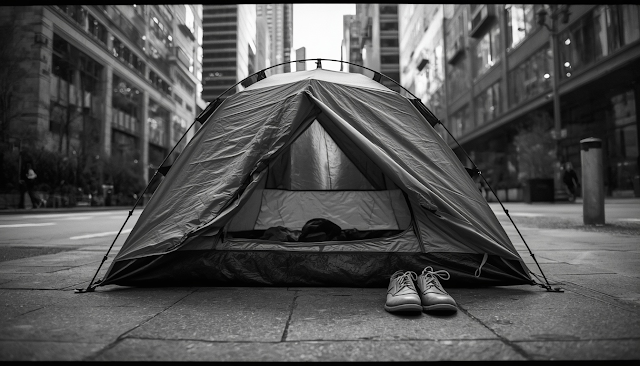
🏛️Chapter 19: The Paradox of the Streets -Homeless
🏛️The Paradox of the Street: Streets Turned into Homes for the Homeless
(Beyond being housing-less, wanderers of helplessness isolated from all worldly relationships.)
[Introduction]
Traveling through the states of America or walking through the centers of major cities, we are forced to confront a massive deficit of modern society, whether we want to or not. It is the landscape of the exponentially increasing homeless population. If the homeless of 10 or 20 years ago were simply individuals pushed onto the streets temporarily due to financial bankruptcy, today’s landscape is inherently different. They now wander the city streets, floating like a massive, isolated island.
[An Honest Gaze: Fear, Hygiene, and the Psychology of the Public]
Let us be honest. When the homeless begin to settle in one place, the air of that neighborhood changes instantly. The streets become filthy, an unknown stench wafts through the air, and an instinctive sense of insecurity and fear creeps in. It might be a natural human self-defense mechanism for anyone, regardless of age or gender, to quietly step away when encountering them. The cold gaze and rejection asking, “Why do they have to live like that?” is a universal, honest emotion felt by ordinary citizens living diligently within the modern system.
[The Essence of the Paradox: Is It Familiarity, Forfeiture, or Laziness?]
Yet, at the same time, we must remember an uncomfortable truth: they too are ‘human beings’ with the same blood and tears as us. What is the fundamental solution to enable them to live as entities possessing human dignity?
Here, we face a very bizarre and sorrowful irony. When looking deeply into many of the homeless, a significant number of them state, “I no longer need a family or a house.” From an ordinary person’s perspective, this is utterly incomprehensible. There are also not a few who resolutely refuse to work even when government or social organizations arrange employment.
How should we view this phenomenon? Is it mere ‘laziness’? Or is it a bizarre ‘freedom’ of those who have completely escaped the social control system? Psychoanalytically, this is closer to ‘learned helplessness,’ where the brain and soul have become completely numb after repeated failures. When a person feels there is nothing left to expect from the world, they dress ‘forfeiture’ in the clothes of ‘familiarity’ to protect themselves. Beyond just being a state of having no house (housing-less), it is a state where social networks and human bonds are entirely destroyed (homeless)—that is the reality of the streets viewed from their perspective.
![[The Present, Map of Self, Modern Deficit] Chapter 19-2](https://ourtimelessnotes.com/wp-content/uploads/2026/07/The-Present-Map-of-Self-Modern-Deficit-Chapter-19-2.png "🏛️Chapter 19: The Paradox of the Streets -Homeless 3")
[Conclusion: A Social Mirror for the Restoration of Dignity]
Fundamentally solving the homeless problem is impossible through temporary expedients like merely cleaning the streets or forcibly isolating them in facilities. The fundamental countermeasure must begin with the ‘restoration of relationships’—reconnecting the shattered self-esteem and broken humanity—rather than just providing a simple ‘roof.’
No matter how forfeited a soul may appear, their human dignity can never completely vanish. As long as we brand them as dropouts of society and look away, the affluence that modern society boasts will be nothing more than an empty sandcastle. We must read the deficits of our system within their wandering.
📂 Attachment Suggestion
The_Psychology_of_Homelessness_and_Systemic_Deficit.txt (English Version)
1. The Psychological Essence of Homelessness: “Housing-less” vs. “Homeless”
- Conceptual Distinction: Defining homelessness merely as a lack of physical shelter (“housing-less”) misses the core issue. Psychiatric and sociological research demonstrates that true homelessness is a state of absolute social rupture (“homeless”), where family, social safety nets, and human bonds are entirely destroyed.
- Learned Helplessness: Individuals who experience repeated failures fall into a psychological state of learned helplessness, numbing the mind and soul. To protect themselves, they dress “forfeiture” in the clothes of “familiarity.” This manifests as a psychological defense mechanism where they decisively refuse institutional housing or employment opportunities.
2. The Impact of Emotional Healing and Social Network Restoration
- Reconnecting Human Bonds: Before providing a simple “roof,” the fundamental step must be the restoration of shattered self-esteem and broken humanity. Research proves that an individual’s will to rehabilitate is significantly revitalized when they are reconnected with an unconditionally accepting community or emotional support system.
- Psychiatric Intervention: When integrated with emotional healing and therapeutic treatments designed to address depression, trauma, and substance addiction, the long-term success rate of exiting the streets is over three times higher compared to providing shelter alone.
3. Comparative Data: Housing First vs. Relational Restoration Policy
| Criteria | Housing First Policy | Relational Restoration Policy |
| Core Approach | Unconditionally providing physical housing (safe rooms, subsidized apartments) as the immediate priority. | Simultaneously activating emotional healing, social networks, and self-esteem restoration programs alongside shelter. |
| Long-term Outcome | Effective at lowering immediate street-homelessness rates, but carries a high risk of relapse back to the streets if emotional isolation and helplessness remain unaddr |
Criteria,Housing First Policy,Relational Restoration Policy
Core Approach,”Unconditionally providing physical housing (safe rooms, subsidized apartments) as the immediate priority.”,”Simultaneously activating emotional healing, social networks, and self-esteem restoration programs alongside shelter.”
Long-term Outcome,”Effective at lowering immediate street-homelessness rates, but carries a high risk of relapse back to the streets if emotional isolation and helplessness remain unaddressed.”,”Requires higher initial costs and time, but yields an overwhelmingly superior success rate in terms of permanent social reintegration and preventing a return to chronic homelessness.”
© Nosgia Mas. All rights reserved.


You May Also Like
🏛️Chapter 3 : The Architecture of Solitude Built Through Being Alone

🏛️Chapter 7: The Silent Satellites-The Heavy Responsibility of a Family Breadwinner