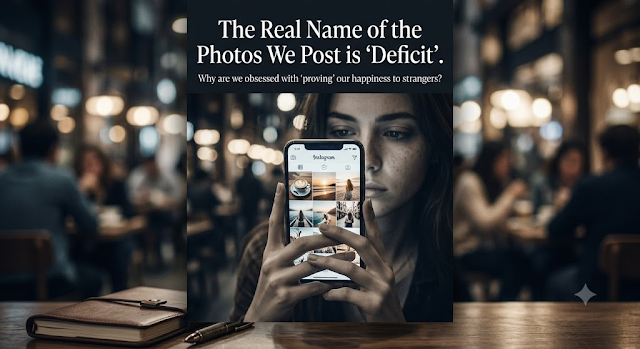
🏛️Chapter 1 : The Real Name of the Photos We Post is ‘Deficit’
🏛️Escaping the “Deficit” Mindset: Living Your Own Life Free from the Gaze of Others
Many people live under the compulsion to prove their worth. They feel they are “enough” only when they achieve more, receive better evaluations, and gain greater recognition.
This desire to prove one’s existence stems from a craving for validation, a sense of insecurity, and the innate human instinct to find meaning in life. Humans cannot find peace in the mere fact of being alive; instead, they constantly seek confirmation of their value.
True self-esteem comes not from proving oneself, but from accepting oneself exactly as one is.
① The Symptom: The Chronic Itch for External Validation
Picture this: It’s 10:00 PM. You are scrolling through a feed saturated with flawless filters, curated experiences, and moments of apparent perfection. A colleague is sipping champagne at a Michelin-starred restaurant; an old high school friend is meditating on a pristine Balinese beach. A subtle, sharp pang of anxiety strikes—a feeling that you are somehow falling behind, that your life is inadequately mundane. You desperately look for something, anything, in your own environment worthy of an “update.” Why? Because you are starving. You are starving for a dopamine hit in the form of a ‘like’, an antidote to the hollow ache of being forgotten. Why are we so chronically addicted to proving our happiness to strangers, even at the cost of experiencing it?
② The Analysis: The Psychopathology of ‘Fear of Erasure’
The core of this behavior isn’t simply vanity; it’s a fundamental crisis of self-validation. Modern psychology diagnoses this as the Fear of Erasure—the terrifying sensation that if an event isn’t documented and validated online, it didn’t truly happen, and by extension, you didn’t truly happen. Neurologically, social media notifications trigger the brain’s pleasure centers, creating an artificial loop of pseudo-connection. But this connection is hollow. We try to fill our internal void with external digital confirmation, yet the loop only intensifies the deficit. Paradoxically, the more one aggressively showcases an idealized life, the louder the silent scream for existential reassurance becomes.

③ The Case Study: From Oil Portraits to Instagram Feeds
Historically, aristocrats commissioned lavish oil portraits to immortalize their status. Modern social media has simply democratized and digitized this vanity, leading to modern psychological phenomena like , where individuals seek plastic surgery to match their filtered online personas.
The cost of this digital mask is severely high. In a landmark study by researchers at NYU and Stanford, individuals who reported significantly lower levels of anxiety and a measurable increase in overall life satisfaction. The evidence is clear: the deeper the artificial connection online, the more severed our relationship becomes with our true, authentic self.
④ The Prescription: Cease the Proof, Commence the Accumulation
To heal this inner drought, you must aggressively halt the exhausting pursuit of external Validation and begin the quiet, patient work of internal Accumulation.
- The Behavioral Reset (Digital Boundary): Impose strict “Dopamine Detox Windows.” Designate one full day a week, or strictly after 9:00 PM every night, when social media apps are completely locked.
- The Cognitive Shift (Converting Loneliness): Actively reframing Loneliness (the painful absence of others) as Solitude (the glorious presence of oneself). Instead of scrolling, open a physical, paper notebook. Write your unfiltered, raw thoughts.
- The Somatic Ritual (Grounding the Senses): Re-engage your overstimulated brain with a daily 30-minute sensory walk, entirely without music, podcasts, or your phone. Let your hands feel the friction of a pen on paper.
⑤ The Timeless Key
So, how can we break free from this compulsion and transform anxiety into a driving force for growth? Here, I propose a path to finding a balance between anxiety and self-esteem through four ways to let go of the need to prove oneself and four ways to manage anxiety healthily.
The four ways to break free from the compulsion to prove oneself are as follows:
First is self-exploration. Try to understand the reasons behind your need to prove yourself. Why do we constantly feel the need to prove who we are? It is crucial to understand the origins of that desire. Explore your inner self by asking questions such as, “Why do I feel at ease only when I am recognized?” and “What am I afraid of?” As this process deepens, we can focus more on our inner voice rather than on external standards.
Second, you must free yourself from the judgment of others. Social comparison fuels anxiety and erodes self-esteem. What matters is not how others view you, but how you evaluate yourself. Practice focusing on yourself rather than others by asking, “How do I view my own life?” and “What kind of life do I truly desire?”
Third, you must confront your inner anxiety. The stronger the desire to prove oneself, the deeper the anxiety and fear that lie beneath it. However, rather than suppressing anxiety, it is important to acknowledge and accept the emotion. You need to be able to look at the feeling exactly as it is, telling yourself, “I am feeling anxious right now.”
Finally, it is about acknowledging your own existence. Regardless of what we achieve—or fail to achieve—we are enough just as we are. We only truly become free when we hold the belief that “I am enough just as I am,” irrespective of our accomplishments. The moment we accept ourselves as we are, we no longer need to struggle to prove our worth.
© Nosgia Mas. All rights reserved.


You May Also Like

🏛️Chapter 6 : The Invisible Architects-Reclaiming the Lost Self in the Landscape of Motherhood

🏛️Chapter 10 : The Crumbling Empire